Office Pest Management
Maintain A Safe And Sanitary Work Environment
Don’t Let Pest Problems Put Your Operation On Hold
If you operate an office building, you need to have a space where employees feel safe and productive. Unfortunately, a pest infestation will only make your employees feel uncomfortable. Moreover, you could find your reputation damaged and temporary or permanent closure if your local health department makes the discovery. At Green Pest Management, we’re proud to provide business owners in Delaware and the surrounding areas with fast, affordable, and effective pest control management that minimize risk and allow you to keep your operations running smoothly. Read on to learn more about our office pest control services we offer. Get in touch with our exterminators if you would like to schedule a free inspection for your property.
What pest issue are you facing in your office?


The Green Pest Management Difference
- Free inspections from our friendly exterminators
- Locally owned with a focus on improving our local communities
- Affiliations with the National Pest Management Association, Home Advisory Association, Better Business Bureau Association, and many other organization
- Transparent, affordable pricing without hidden charges or unnecessary fees
- Discreet, non-judgmental service that protects your privacy and reputation


Personalized Office Treatment Plans

Safe Methods That Protect Your Workers

Your Satisfaction Is Always Guaranteed

Free Follow-Up Treatment and Support If Needed
Protecting Your Staff And Clientele Has Never Been Easier
Maybe you’ve seen ants or cockroaches in the break room, or perhaps staff members noticed rodents in your storage rooms. No matter what kind of pest is in your office, it’s crucial to contact a commercial pest control company a.s.a.p. In addition to putting employee health at risk, you might find your business’ reputation damaged if word gets out that you’ve allowed a serious problem to go untreated.
Instead of trying to handle the problem yourself with DIY pest control solutions—that may not deliver the results you need, contact the experienced exterminators at Green Pest Management. Keep reading to learn more about our office pest control management. We have more than two decades of industry expertise. Above all, we’ll work diligently to ensure that the problem is treated quickly and protect from pests entering in the future.

Safeguard Your Workplace’s Productivity
No matter what industry you serve, efficiency is a cornerstone of every business model. From power outages and equipment failures to clutter and pest infestations, there’s no shortage of opportunities for your operation’s efficiency to take a hit.
Offices provide a warm, dark hiding place for pests such as ants, cockroaches, spiders, rodents, and more; all of which can create an unsafe workplace and negatively impact productivity.
No matter what kind of pest you’ve noticed in your office, the exterminators at Green Pest Management will create a personalized plan that addresses your needs to safeguard your operation.
Call Green Pest Management Today
At Green Pest Management, we understand that you have more important things to do than take on a pest control job by yourself. Between phone calls, meetings, and daily tasks, you shouldn’t have to worry about becoming a commercial pest control expert.
If you’ve noticed common signs of pests such as rodent droppings, gnaw marks, shed wings, or you’ve actually seen a pest around your office, know that affordable protection is just a call away. At a time that works for you, we’ll do a free inspection to help you understand the scope of the problem and your options. In addition we’ll treat the problem as soon as possible, to ensure that it doesn’t return. We’ll gladly provide you with follow-up inspections or treatments if necessary.
In short, Don’t let your operation grind to a halt due to pests—invest in your peace of mind and call our office pest control experts today.
Office Pest Control – Q&A
How to Control Pests in the Office?
The best way to control pests in the office is to combine sanitation, building maintenance, monitoring, and targeted treatment. Food crumbs, open snacks, standing water, and overflowing trash should be removed because they can attract insects and rodents. Break rooms, kitchens, desks, storage areas, and restrooms should be cleaned regularly. Gaps around doors, windows, pipes, vents, and utility lines should be sealed to reduce pest entry. Leaks, condensation, and damp areas should be repaired because many pests depend on moisture. Monitoring traps can help detect activity before a larger infestation develops. Pesticides should be used only when necessary and according to the product label. Ongoing inspections and employee cooperation are essential for long-term office pest control.
What Are the Most Common Pests in the Workplace?
The most common pests in the workplace include cockroaches, ants, flies, mice, rats, spiders, and stored-product insects. Cockroaches often appear near kitchens, appliances, plumbing, and other warm or damp locations. Ants may enter offices in search of sugary foods, grease, protein, or water. Flies can develop near trash, drains, spilled drinks, and decaying organic material. Mice and rats may enter through small structural openings and hide in storage rooms, ceilings, or wall spaces. Stored-product beetles and moths can infest dry foods kept in office kitchens or vending areas. Spiders may appear where insect prey is available, especially near windows, lights, and quiet corners. The pests found in a workplace depend on the building, climate, sanitation, and surrounding environment.
How to Remove Bugs From an Office?
The most effective way to remove bugs from an office is to identify the insect before choosing a treatment. Different pests require different control methods, so random spraying may not solve the problem. Food waste, crumbs, cardboard, clutter, and standing water should be removed from affected areas. Desks, cabinets, appliances, drains, and storage spaces should be inspected for insects, eggs, droppings, or shed skins. Cracks and openings should be sealed to prevent additional bugs from entering. Traps, baits, vacuuming, or targeted pesticide applications may be used depending on the species. Repeated sightings may indicate a hidden breeding site or an established infestation. A commercial pest control professional should handle serious or recurring office pest problems.
How to Control Cockroaches in the Office?
The best way to control cockroaches in the office is to remove food, moisture, hiding places, and entry routes. Crumbs, grease, spills, and open food containers should be cleaned or sealed promptly. Leaking pipes, damp cabinets, condensation, and standing water should also be corrected. Cockroaches often hide behind appliances, beneath sinks, inside cabinets, and within narrow cracks. Sticky monitoring traps can help determine where activity is concentrated. Gel baits and other targeted treatments are usually more effective than widespread spraying when used correctly. Cracks around plumbing, walls, doors, and cabinets should be sealed after active hiding areas are identified. Persistent cockroach activity should be evaluated by a licensed pest control professional because complete control often requires follow-up treatment.
What Attracts Cockroaches in the Office?
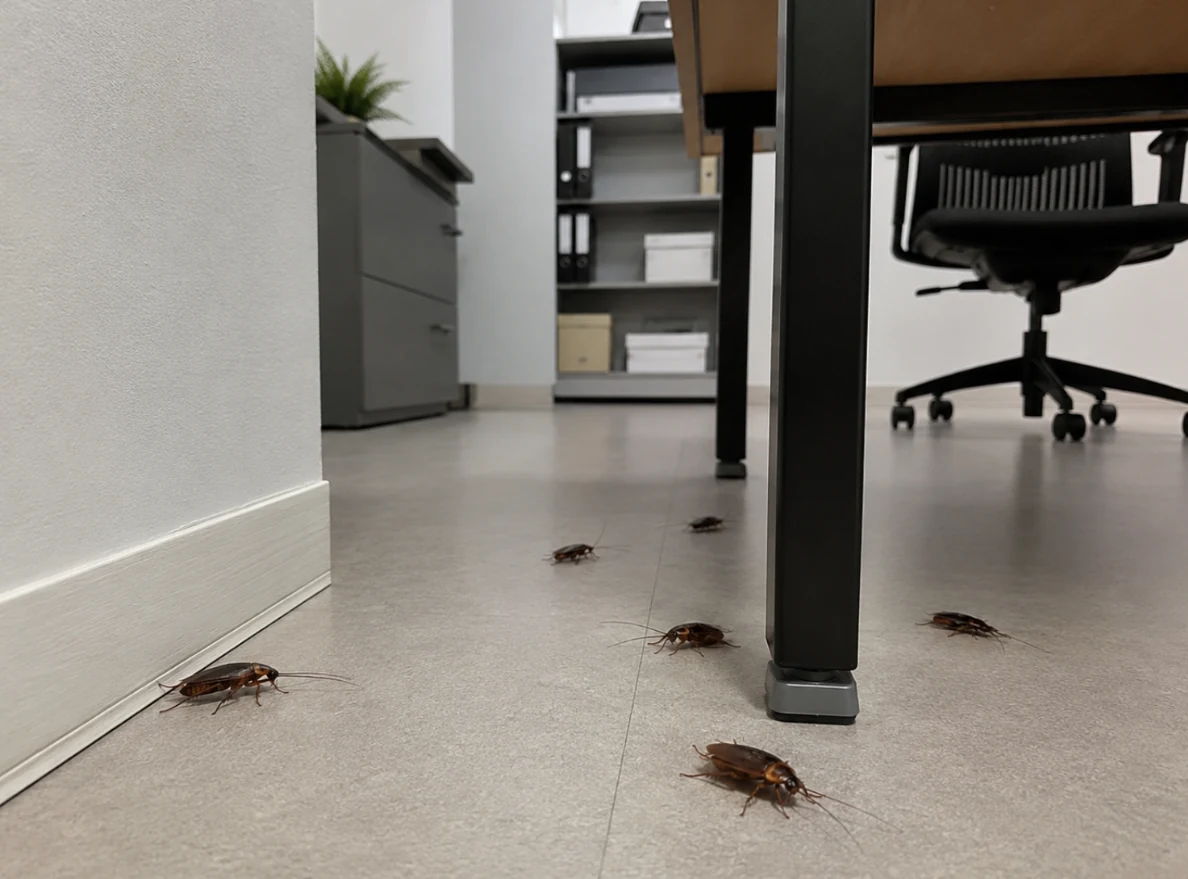
Cockroaches are attracted to offices by food, moisture, warmth, and protected hiding places. Crumbs, sugary drinks, grease, open snacks, and food left in desks can provide reliable food sources. Leaking pipes, damp cabinets, condensation, and standing water can supply the moisture cockroaches need. Break rooms, vending areas, kitchens, restrooms, and appliance spaces are common activity zones. Cardboard boxes, clutter, cracks, and wall voids can give cockroaches shelter during the day. They may also enter through deliveries, plumbing openings, door gaps, or neighboring units. Reducing food residue, moisture, clutter, and entry points makes an office less suitable for cockroaches.
Why Is Pest Control Important for Offices?
Pest control is important for offices because pests can affect sanitation, employee comfort, property, and business operations. Cockroaches, rodents, flies, and ants may contaminate food, surfaces, or stored materials. Rodents can also damage wiring, insulation, packaging, and office equipment through gnawing. Pest sightings may distract employees, create complaints, and reduce confidence in the workplace. Regular inspections can identify leaks, structural openings, food waste, and early pest activity before a larger infestation develops. Professional pest management can also reduce unnecessary pesticide use by focusing on prevention and targeted treatment. Effective office pest control supports a cleaner, safer, and more productive working environment.
How Often Should Pest Control Be Done in an Office?
Pest control in an office is often performed monthly or quarterly, depending on the building’s risk level. Offices with kitchens, food storage, heavy foot traffic, or previous infestations may need monthly service. Lower-risk workplaces may be adequately managed with quarterly professional inspections and regular internal monitoring. Break rooms, restrooms, storage areas, basements, and waste zones should be checked more frequently than ordinary desk areas. Any report of cockroaches, rodents, bed bugs, or repeated insect activity should trigger an immediate inspection. The service schedule should also consider the building’s age, local climate, neighboring businesses, and maintenance history. Pest control frequency should increase whenever monitoring shows that current measures are not keeping activity under control.
How to Get Rid of Pests in the Workspace?
The best way to get rid of pests in the workspace is to identify the species and remove the conditions supporting it. Food, crumbs, spills, standing water, and open waste should be cleaned up promptly. Cracks, damaged door seals, plumbing gaps, and other entry points should be repaired or sealed. Desks, cabinets, break rooms, storage spaces, and equipment areas should be inspected for droppings, insects, nests, or damaged materials. Traps, baits, vacuuming, and other control methods should be selected for the specific pest involved. Pesticides should be used only when necessary and according to the product label. Long-term control depends on continued cleaning, maintenance, monitoring, and employee cooperation.
Cited Sources
U.S. Environmental Protection Agency. (2026, July 22). Integrated pest management (IPM) principles. https://www.epa.gov/safepestcontrol/integrated-pest-management-ipm-principles (U.S. EPA) (US EPA)
Centers for Disease Control and Prevention. (2024, April 8). Controlling wild rodent infestations. https://www.cdc.gov/healthy-pets/rodent-control/ (CDC) (CDC)
University of Minnesota Extension. (2024). Cockroaches. https://extension.umn.edu/insects-infest-homes/cockroaches (University of Minnesota Extension) (University of Minnesota Extension)
U.S. Environmental Protection Agency. (2026, June 2). Introduction to pesticide labels. https://www.epa.gov/pesticide-labels/introduction-pesticide-labels (U.S. EPA) (US EPA)