
Motel and Hotel Pest Control
Keep Unwanted Guests Out Of Your Rooms!
Protect Your Guests And Your Reputation
As business owners ourselves, we know just how important it is to maintain a good reputation in the community. Whether you operate a large hotel known around the nation or a locally owned motel—a pest infestation is the last thing you want your name to be associated with. If a guest falls ill or you fail a health inspection, you could find your business permanently damaged. At Green Pest Management, we proudly provide fast, affordable, and discreet motel and hotel pest control services that allow you to focus on the things that matter most: running your business and ensuring a comfortable stay. Keep reading below to learn more about how we can help and why you should choose us. Give us a call when you’re ready to schedule a no-cost inspection for your property.
Why Choose The Team At Green Pest Management?
- Thorough inspections and treatments
- Transparent pricing without fine print or hidden costs
- Locally owned with a focus on bettering the communities we serve
- Fast treatments for current infestations
- Guidance about how to prevent future infestations
- Affiliations with the National Pest Management Association, Home Advisory Association, Better Business Bureau Association, and many other organizations


Customized Hotel and Motel Treatment Plans

Non-Toxic Treatments That Protect Guests and Staff

Unparalleled Satisfaction Guarantee

No-Cost Follow-Up Treatments If Needed
Keep Your Hotel Or Motel A Comfortable Place To Stay
If you own or operate a motel or hotel, then it’s safe to assume that you have a lot on your plate. From working to increase efficiency to day-to-day tasks like payroll, ordering, and planning for the future, you do more than your fair share of labor. A pest infestation will increase your workload tenfold, especially when you consider that pests can quickly spread between rooms if not contained quickly. Moreover, an infestation could saddle you with the additional task of calming down upset guests and working overtime to save your reputation from devastation.
Instead of taking on these enormous workloads on your own, call a professional exterminator company that can help you treat the problem before it gets out of hand. We’ve worked with large commercial entities and homeowners for more than two decades and can quickly jump into action when you need it most.

Common Pests In New Castle
Hotels and motels are in a unique—and sometimes troubling position. Guests from across the state, country, and perhaps even the world, are all giving you their business. There’s no doubt that this is a good thing from a business perspective, but it’s a near guarantee that guests will bring pests along for the ride at some point.
Even if your cleaning crew does an exceptional job and is able to clean every room from top to bottom, nearly every hotel or motel serves food of some kind. This can attract pests and make it even more likely that ants, cockroaches, rodents, termites, or silverfish will make their way inside.
The Benefits Of Investing In Motel and Hotel Pest Control
- Information: Knowledge is powerful. In the pest control industry, information about how pests are getting into your property is the key to solving the problem and keeping them out. If you choose to work with Green Pest Management for your commercial pest control needs, you’ll benefit from knowing exactly how to keep the problem from occurring down the road.
- Effectiveness: You can’t afford to take chances when it comes to motel and hotel pest control. DIY methods and the up-and-coming pest control company offering unbelievable rates and too-good-to-be-true promises that aren’t backed up by reviews or tangible results aren’t going to deliver the results you need. When you choose us, you’re choosing to work with a company that can show you an extensive track record of success and hundreds of five-star reviews.
- Peace of Mind: You deserve to sleep as well as your guests, but you won’t be able to if you’re constantly putting out fires and wondering when the next infestation will occur. Instead of thinking about commercial pest control as a dent in your bottom line, think about it as an investment in your peace of mind.

Contact Green Pest Management Today
Whether you’re currently dealing with an infestation or you want to take preventative measures and prevent one from occurring in the first place, you can count on the exterminator experts at Green Pest Management to get the job done.
We’ll come to your property at a time that works for you and treat the issue discreetly, allowing you to keep your guests unworried and your reputation intact. We have incredibly high standards when it comes to our work, but if you aren’t satisfied with the results, we’ll come back and provide you with free re-treatments until you are.
We are proud to serve quality commercial pest control solutions to businesses throughout Delaware, Southern Pennsylvania, Eastern Maryland, and Western New Jersey. Don’t let unwanted pests drive guests away—call Green Pest Management for a free inspection.
Motel and Hotel Pest Control – Q&A
What Should Hotel Owners Know About Pest Control?
Hotel owners should know that pest control requires continuous prevention, monitoring, and rapid response. Guest rooms, kitchens, laundry areas, storage spaces, loading zones, and waste areas can attract different pest species. Even a single pest sighting may harm guest confidence and lead to negative reviews. Hotels should use an integrated pest management program that combines cleaning, exclusion, maintenance, inspection, and targeted treatment. Staff should be trained to report droppings, insects, damaged materials, unusual odors, and other warning signs immediately. Service records can help management identify recurring problems and confirm that corrective work has been completed. Pest control methods must also protect guests, employees, food, linens, and sensitive surfaces. Regular professional inspections and proactive treatments are usually more effective than waiting for a major infestation to appear.
How to Get Rid of Pests in a Hotel?
The best way to get rid of pests in a hotel is to identify the species and determine where it is entering, feeding, or hiding. Affected rooms and nearby areas should be inspected because pests can move through walls, hallways, pipes, or housekeeping equipment. Food waste, standing water, clutter, and dirty laundry should be removed or managed correctly. Cracks, damaged screens, door gaps, plumbing openings, and other access points should be repaired. Traps, monitoring devices, baits, or other control methods should be selected for the pest involved. Pesticides should only be used according to label directions and away from guests, food, and exposed personal items. Severe or recurring infestations should be handled by a licensed commercial pest control professional. Long-term control depends on follow-up inspections, staff cooperation, sanitation, and building maintenance.
What Are Common Pests That Can Be Found in a Hotel?
Common hotel pests include bed bugs, cockroaches, ants, flies, mice, rats, fleas, and stored-product insects. Bed bugs may be transported in luggage, clothing, furniture, or personal belongings and can hide near beds and upholstered items. Cockroaches often gather around kitchens, drains, plumbing, laundry rooms, and other warm or damp areas. Ants may enter guest rooms or food-service spaces while searching for sugar, grease, protein, or water. Flies can develop near waste, drains, spilled beverages, kitchens, or decaying organic material. Rodents may enter through wall openings, loading areas, utility gaps, or damaged doors. Fleas may occasionally be introduced by animals or infested belongings, especially in pet-friendly hotels. The exact pest risks depend on the hotel’s location, climate, building design, sanitation, guest activity, and surrounding properties.
Why Are There Cockroaches in a Hotel?
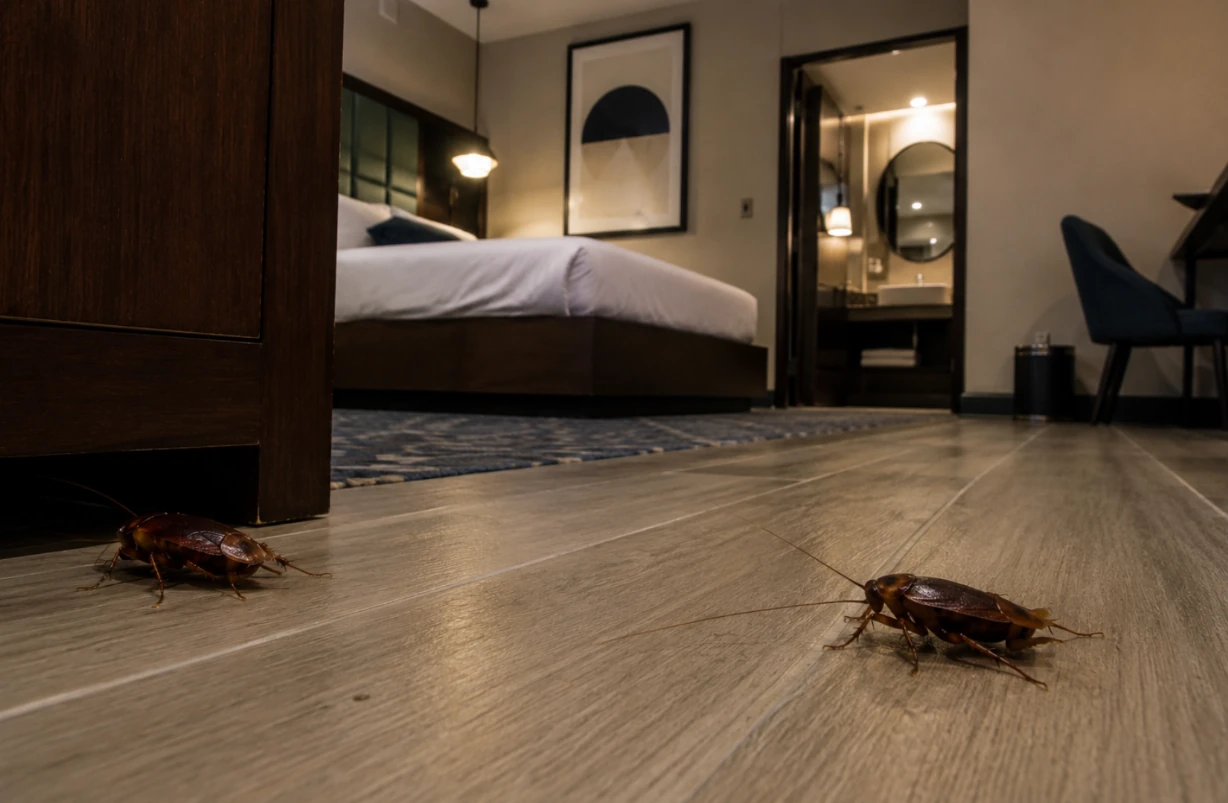
Cockroaches may appear in a hotel because the building offers warmth, moisture, food, and protected hiding places. They can enter in deliveries, cardboard boxes, luggage, appliances, or through openings connected to neighboring areas. Food crumbs, grease, spilled drinks, and poorly sealed waste can provide nourishment. Leaking pipes, condensation, drains, and damp utility spaces may supply the water they need. German cockroaches commonly remain near kitchens, laundry areas, plumbing, and warm equipment. Their flattened bodies allow them to hide inside narrow cracks, cabinets, wall voids, and furniture. One cockroach may have entered accidentally, but repeated sightings, droppings, egg cases, or shed skins suggest established activity. Effective control requires removing food and moisture, sealing entry points, improving sanitation, and using targeted treatments.
What Do Hotels Do to Control Bed Bugs?
Hotels control bed bugs through regular inspections, rapid reporting, and targeted treatment of affected rooms. Housekeeping staff are often trained to recognize dark fecal spots, shed skins, eggs, live insects, and unexplained blood marks near sleeping areas. When bed bugs are suspected, the room and nearby rooms should be inspected because the insects can move through wall openings, hallways, or housekeeping equipment. Bedding, curtains, upholstered furniture, headboards, mattress seams, and luggage areas require careful examination. Control methods may include high-temperature drying, professional heat treatment, steam, vacuuming, mattress encasements, and insecticides labeled for bed bugs. Most infestations require more than one treatment because eggs or hidden insects may survive the first visit. Hotels should also inspect carts, linens, furniture, and stored belongings to reduce the chance of spreading bed bugs to other rooms. Bed bugs are not caused simply by poor cleanliness, since they are commonly introduced through luggage, clothing, furniture, or personal belongings.
How to Control Rats in a Hotel?
The best way to control rats in a hotel is to remove their food, water, shelter, and access to the building. Waste should be stored in closed containers, food spills should be cleaned promptly, and outdoor garbage areas should be kept orderly. Damaged doors, loading-dock gaps, vents, drains, and openings around utility lines should be repaired or sealed with rodent-resistant materials. Storage rooms, kitchens, laundry areas, basements, ceilings, and landscaping should be inspected for droppings, gnaw marks, tracks, nests, and greasy rub marks. Traps should be placed along likely travel routes and checked regularly by trained personnel. Rodenticides may be appropriate in some controlled locations, but they must be used according to the label and managed carefully to protect guests, employees, pets, and wildlife. A licensed pest professional can determine whether Norway rats, roof rats, or another rodent species is involved and adjust the control plan accordingly. Long-term rat control requires continued monitoring and building maintenance even after visible activity has stopped.
Why Is Pest Control Important for Hotels?
Pest control is important for hotels because pest activity can affect guest comfort, sanitation, property condition, and the hotel’s reputation. Bed bugs can bite guests, while cockroaches, rodents, flies, and ants may contaminate food, surfaces, or stored materials. Rodents may also damage wiring, insulation, packaging, furniture, and parts of the building through gnawing. A single pest sighting can lead to complaints, room refunds, negative reviews, or lost future bookings. Routine inspections help hotel staff identify small problems before they spread between guest rooms or service areas. Pest management also supports safer conditions in kitchens, restaurants, laundry rooms, waste areas, and storage facilities. Accurate service records allow management to track findings, completed repairs, treatments, and follow-up inspections. Effective hotel pest control therefore protects guests, employees, property, business operations, and public confidence.
How Often Should Pest Control Be Done in a Hotel?
Pest control in a hotel should usually be performed on a regular schedule, with monthly professional service serving as a practical baseline for many properties. Higher-risk hotels may need weekly or biweekly inspections in kitchens, laundry rooms, waste areas, storage spaces, and locations with previous pest activity. Guest rooms should also be checked routinely by trained housekeeping and maintenance employees. The correct frequency depends on the hotel’s size, location, building condition, occupancy rate, food-service operations, and pest history. Bed bug concerns require immediate inspection rather than waiting for the next scheduled visit. Pest activity should be documented so management can identify recurring problems and confirm that corrective actions are working. Inspection frequency should increase whenever cockroaches, rodents, bed bugs, or other pests are detected. Effective hotel pest control is based on continuous monitoring and prevention, not simply applying pesticides at fixed intervals.
How Does a Motel Get Bed Bugs?
A motel usually gets bed bugs when they are unintentionally carried into the building in luggage, clothing, furniture, bags, or other personal belongings. Bed bugs do not fly or jump, but they can crawl from an infested item into a mattress, headboard, bed frame, or nearby crack. Frequent guest turnover increases the number of opportunities for bed bugs to be introduced. Used furniture, mattresses, and upholstered items can also bring bed bugs into a motel if they are not inspected carefully. Once inside, the insects may spread to nearby rooms through wall openings, electrical spaces, hallways, or items moved by staff. Housekeeping carts, linens, and guest belongings may contribute to movement if infested materials are handled improperly. Bed bugs are not proof that a motel is dirty because they feed on blood and can survive in clean or poorly maintained rooms. Early reporting, careful inspections, and professional treatment are essential for preventing a small introduction from developing into a larger infestation.
Cited Sources
U.S. Environmental Protection Agency. (2025, September 2). Integrated pest management principles. https://www.epa.gov/safepestcontrol/integrated-pest-management-ipm-principles (U.S. EPA) (US EPA)
U.S. Environmental Protection Agency. (2026, March 30). Controlling bed bugs using integrated pest management (IPM). https://www.epa.gov/bedbugs/controlling-bed-bugs-using-integrated-pest-management-ipm (U.S. EPA) (US EPA)
Centers for Disease Control and Prevention. (2024, April 8). Controlling wild rodent infestations. https://www.cdc.gov/healthy-pets/rodent-control/index.html (CDC) (CDC)
University of Minnesota Extension. (n.d.). Cockroaches. https://extension.umn.edu/insects-infest-homes/cockroaches (University of Minnesota Extension) (extension.umn.edu)
